
The upward movement in aluminium futures – rising by 2.25 to hit Rs 350.80 per kilogram on the Multi Commodity Exchange (MCX) – reflects a classic interaction between physical market realities and derivatives trading behavior. On the Multi commodity Exchange, the price of aluminium for delivery in August edged up by Rs 2.25, or 0.65 percent, to Rs 350.80 per kg in 372 lots. Analysts said fresh positions created by traders amid demand from consuming industries supported aluminium prices in the futures market.
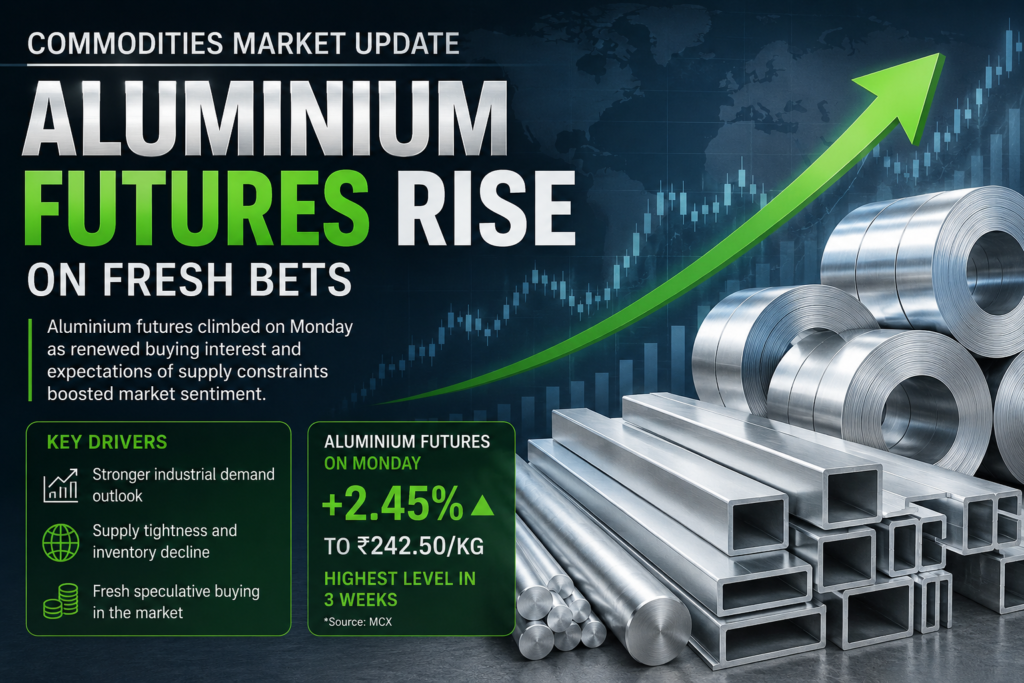
Aluminium Futures Rise on MCX Amid Fresh Bets : For more information, refer to the post by Rediff Money Desk, New Delhi .
- Decoding the Market Mechanics : To understand why this price shift happened, it is essential to break down the specific drivers cited in the update
- Positive Trend in the Spot Market : The “Spot Market” refers to the physical market where aluminium is bought and sold for immediate delivery. When physical demand pushes spot prices up, future prices naturally follow. Futures contracts derive their intrinsic value from current and expected future physical market conditions.
- Fresh Position-Building (Speculative Bets) : Traders and speculators anticipated that prices would climb further. By building ”fresh long positions” (buying contracts with the expectation of selling them higher later), they injected fresh capital and liquidity into the market. This buying pressure directly drove the contract price up.
- Consumer Industry Demand : End-user sectors – such as automobile manufacturing, packaging, construction, and electrical wiring – require a steady intake of aluminium. When these consuming industries step up their procurement, it signals robust fundamental consumption, giving traders the confidence to bid up futures prices.
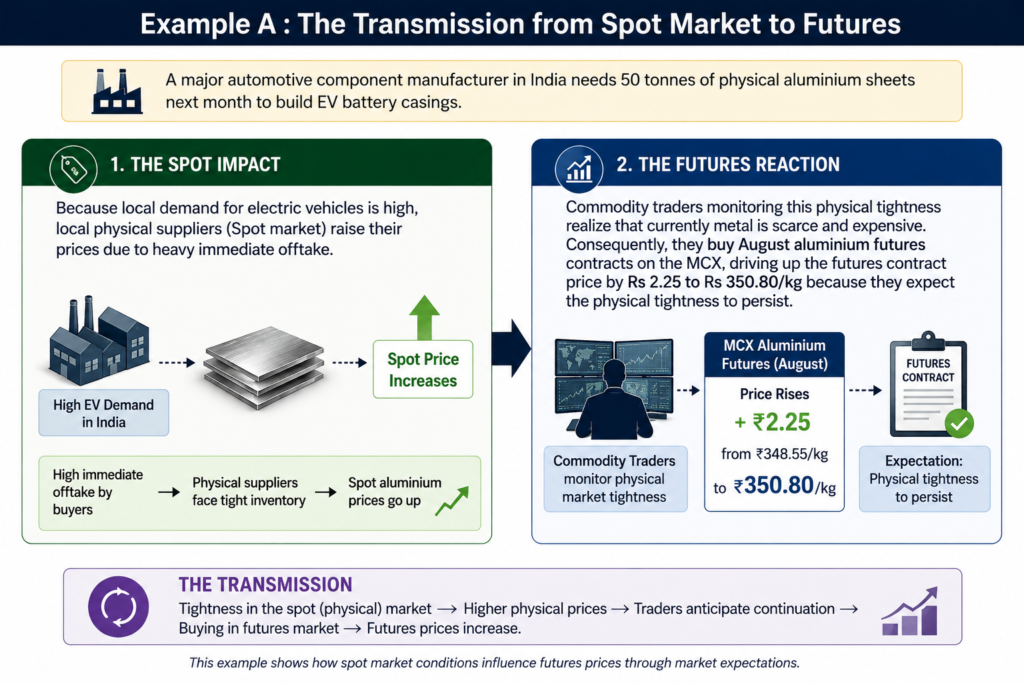
Example A : The Transmission from Spot Market to Futures — Imagine a major automotive component manufacturer in India that needs 50 tonnes of physical aluminium sheets next month to build EV battery casings.
- The Spot Impact : Because local demand for electric vehicles is high, local physical suppliers (Spot market) raise their prices due to heavy immediate offtake.
- The Futures Reaction : Commodity traders monitoring this physical tightness realize that currently metal is scarce and expensive. Consequently, they buy August aluminium futures contracts on the MCX, driving up the futures contract price by Rs 2.25 to Rs 350.80/kg because they expect the physical tightness to persist.
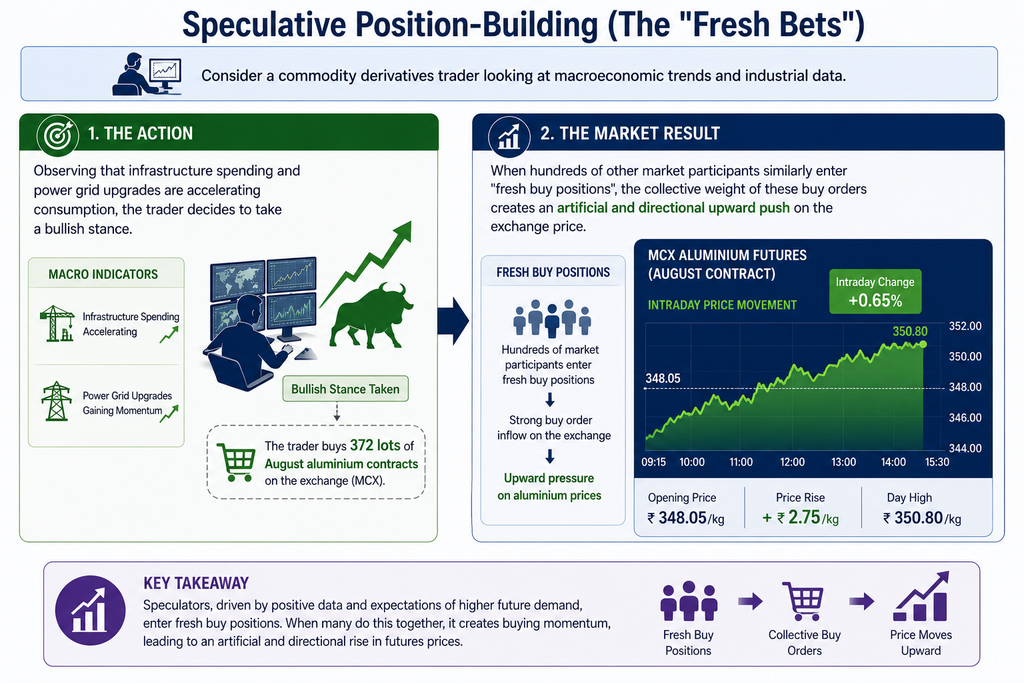
Example B : Speculative Position-Building (The “Fresh Bets”) — Consider a commodity derivatives trader looking at macroeconomic trends and industrial data.
- The Action : Observing that infrastructure spending and power grid upgrades are accelerating consumption, the trader decides to take a bullish stance.
- The Market Result : They buy 372 lots of August aluminium contracts. When hundreds of other market participants similarly enter “fresh buy positions”, the collective weight of these buy orders creates an Artificial and directional upward push on the exchange price, causing the intraday trick of +0.65%.
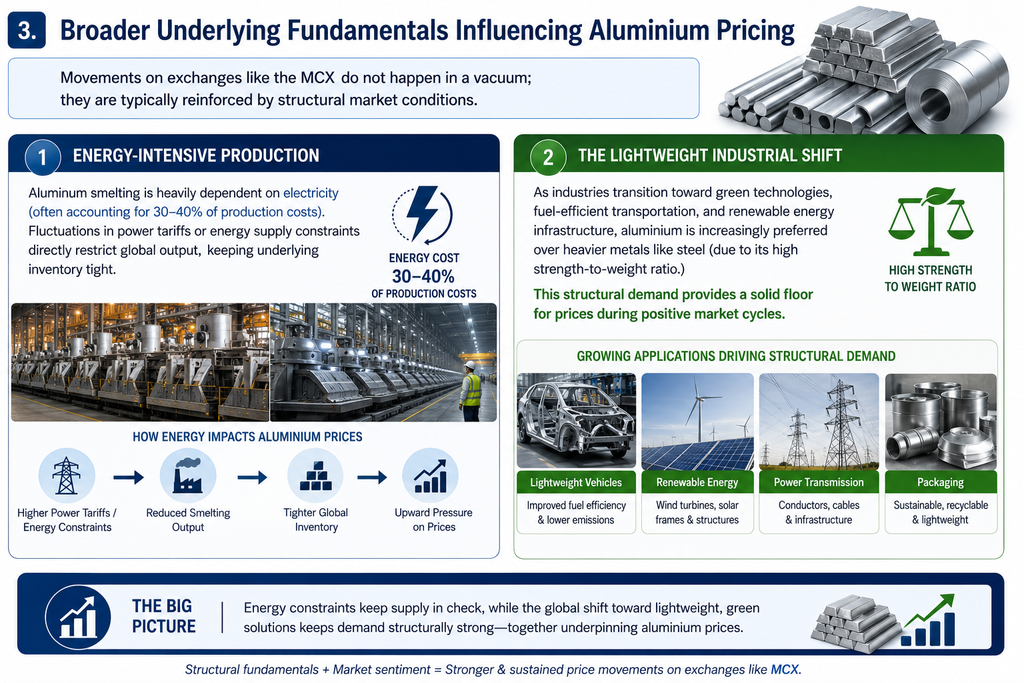
3. Broader underlying fundamentals influencing Aluminium pricing : Movements on exchanges like the MCX do not happen in a vacuum; they are typically reinforced by structural market conditions.
- Energy-Intensive production : Aluminum smelting is heavily dependent on electricity (often Accounting for 30-40% of production costs). Fluctuations in power tariffs or energy supply constraints directly restrict global output, keeping underlying inventory tight.
- The Lightweight Industrial shift : As industries transition toward green technologies, fuel-efficient transportation, and renewable energy infrastructure, aluminium is increasingly preferred over heavier metals like steel (due to its high strength-to-weight ratio.) This structural demand provides a solid floor for prices during positive market cycles.
Comparative Analysis — Theory V/S The Aluminium Futures Market update :
To understand the mechanics behind the rise in aluminium futures to Rs 350.80 per kg. We can examine traditional economic theories of pricing, Market efficiency, and sentiment-driven trading.
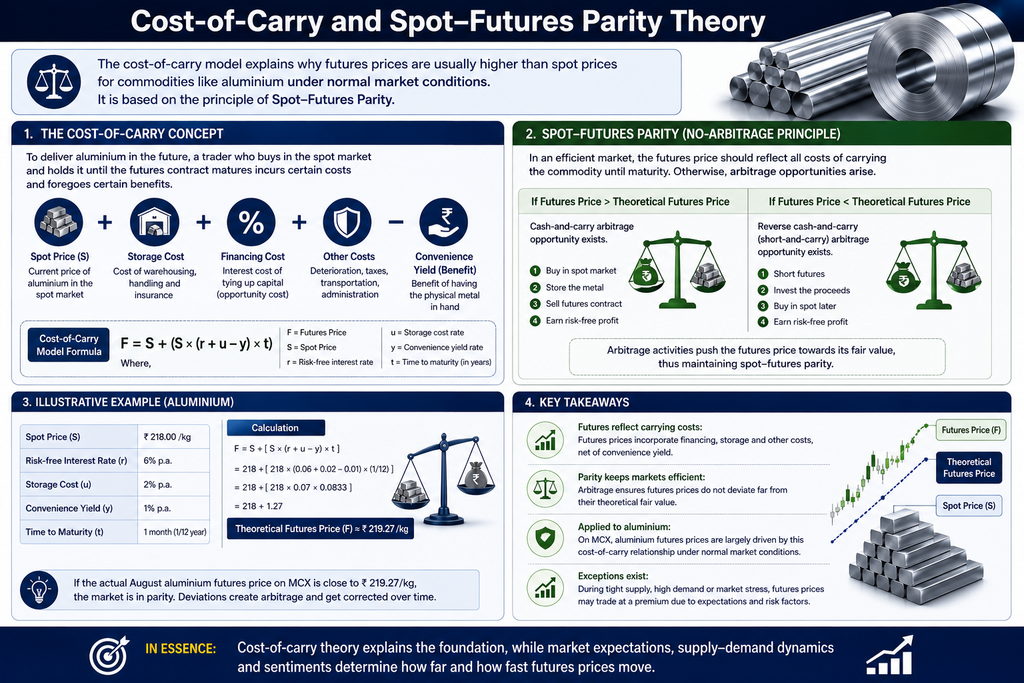
- The Cost-of-Carry and Spot-Futures parity theory :-
- The Traditional Theory : In classic Financial economics, the pricing of a futures contract is fundamentally tied to the spot market through the Cost-of-Carry Model.
- Formula : Futures price = Spot price + Cost of Carry (Storage Costs + Interest/Financing) – Conveyance yield.
- Comparison : The report notes that aluminium futures rose “As Speculators built up fresh positions amid a positive trend in the Spot market.” This demonstrates the direct linkage dictated by parity theory. When the physical spot price ticks upward due to immediate scarcity or consumption demand, the theoretical base of the futures contract shifts higher. Traders simultaneously factor in a high convenience yield – the implicit benefit of holding the physical metal rather than a paper claim – which encourages aggressive buying and narrows or expands the futures premium accordingly.
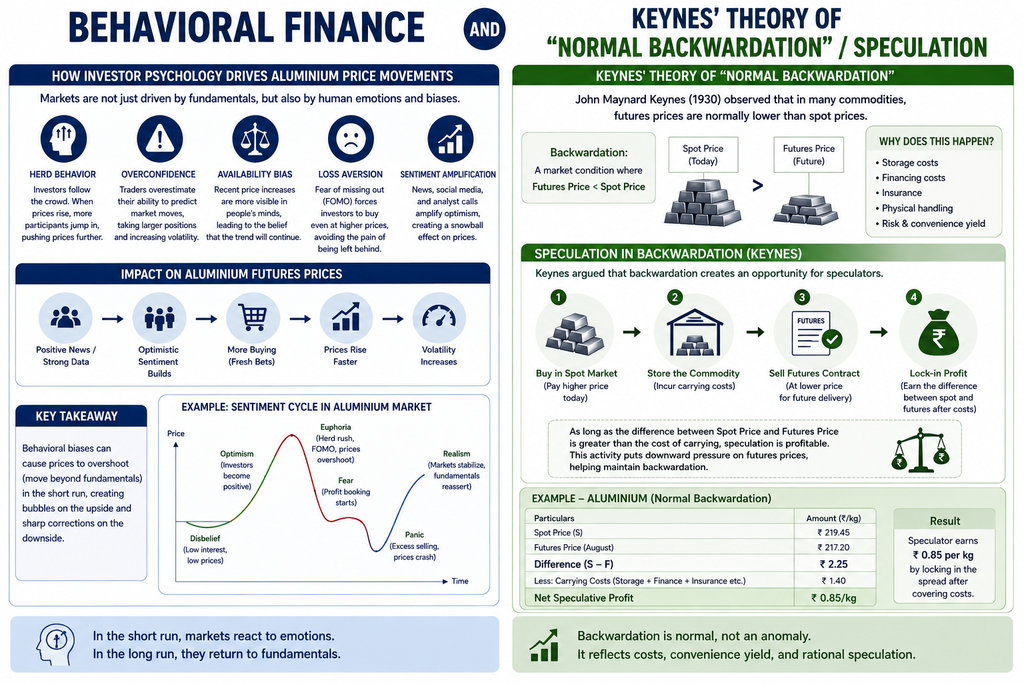
- Behavioral Finance and Keynes’ Theory of “Normal Backwardation” / Speculation :-
- The Traditional Theory : John Maynard Keynes introduced the concept that future markets often feature speculators who absorb risk from hedgers. In standard market cycles, speculative capital flows in where there is a perceived momentum or a structural shift in supply and demand expectations.
- Comparison to the Update : The phrase “Speculators built up fresh positions” highlights the behavioral aspect of momentum trading. Rather than just commercial hedgers (like Aluminium smelters or cable manufacturers) locking in prices, outside speculators drove the 372 traded lots higher by betting on trend continuation. In behavioral terms, this reflects herd behavior and extrapolative expectations, where market participants project recent positive spot trends directly into future price appreciation.
| FEATURE | CLASSICAL ECONOMIC THEORY | THE ALUMINIUM MARKET EVENT (MCX) |
| Price Anchor | Spot price dictates long-term equilibrium via arbitrage. | Spot market strength immediately dragged August delivery futures up by Rs 2.25. |
| Role of Speculators | Provide market liquidity and absorb risk from commercial producers/consumers. | Acted as the primary momentum engine, creating “fresh buy positions” that amplified the price rally. |
| Demand driver | Rational utility maximization by industrial end-users. | Real-world consumption demand from downstream sectors (auto, packaging, electrical). |
Structural Fundamentals supporting the Metal : Movements on the MCX do not occur in a vacuum. Long-term trends continue to provide a solid floor for industrial metals like aluminium.
- Energy Intensity : Aluminium smelting is famously energy-demanding, with electricity consumption accounting for a massive share of total production costs. Power tariff adjustments or regional energy constraints invariably restrict global output, keeping Inventories lean.
- The Lightweight Revolution : As Industries across the globe pivot toward sustainability, lightweight materials are increasingly favored over heavier metals like steel. From renewable energy grid installations to fuel-efficient transportation, the structural shift toward low-carbon tech ensures robust, long-term consumption patterns.
Real-world drivers behind the Rally : Market updates often attribute price changes to broad concepts like “demand” and “speculation”, but what do these terms exactly mean?
- The Industrial Pull (Spot Market Strength) : Consider a domestic manufacturer producing electric vehicle battery components or special wiring. When urban infrastructure projects and EV manufacturing accelerate, these industrial buyers need a steady, immediate supply of physical aluminium sheets. As physical inventories tighten in local hubs, spot prices rise. Commodity traders monitoring these supply chains immediately price that physical tightness into the derivatives market.
- The Speculative Multiplier : Imagine a commodity desk analyst observing robust macro-economic data indicating sustained infrastructure spending. Anticipating that supply constraints will worsen before they improve, the trader opens fresh buy positions. When hundreds of market participants independently execute similar strategies, the collective influx of capital pushes exchange prices higher – explaining the 0.65% bump observed in the August contracts.
Key Takeaway for Market watchers : The recent uptick in aluminium futures is more than just a random daily fluctuation; it is a clear reflection of supply chain pressures meeting active capital deployment.